The vitriolic nature of the relationship between the USA and one of the ignominious members of the now infamous 'Axis of Evil';
North Korea, should properly be viewed in its historic context. This is especially important as the war of words between these 2 States has again quickly and dramatically intensified. Why is there animosity between these 2 parties? What historic events could have shaped this situation?
In the aftermath of WWII, a war in which our history books lie to us by explaining that the USA was forced into the war after Roosevelt and Co organized Japan's sneak attack at Pearl Harbour; a war the USA fought on 2 fronts; a war, we're told, in which the US was forced to use atomic weapons to end in a timely manner the Pacific war and save American lives. After all that, one might reasonably assume the American people would want to enjoy the hard-fought peace their young men had earned them with their sacrifices in Europe and Asia. The jewish bankers, however, had other plans. And the military establishment was happy to do what it does best: follow orders. Thus, only a few short years after the Japanese surrender in August of 1945, the USA was again sending young men to fight and kill and be killed in Asia.

Japan ruled the Korean peninsula for most of the first half of the 20th century, up until their capitulation in WWII. After Japan's unconditional surrender, the United States divided Korea along the 38th parallel, in essence giving the North to the USSR to control while the US kept control of points South. As Britain did with Ireland 30 years earlier, a nation and its people were divided by a foreign power along an arbitrary line.

It did not take long for this brilliant piece of statesmanship to devolve into war. The United Nations Security Council passed a resolution in 1950 authorizing an 'international peace keeping force' to go fight for the South against the Soviet Union/China backed North. Russia could have vetoed this vote, but Russia chose instead to boycott the UN at this very moment in history. The US (in an example that would repeat itself over and over in the coming decades) provided nearly 90% of the Non-Korean soldiers and the funding for this 'international' effort. After 3 years and millions of deaths and the wholesale destruction of Korean cities, towns and villages, the UN brokered an Armistice which again divided the country along the 38th parallel; a situation that still stands today. Despite lives lost, virtually nothing was gained by either side. So who would gain by such a seemingly stupid war police action? Hmmm.
 |
| some real 'freedom loving' nations flags are represented on this propoganda poster |
In the ensuing years, there have been minor skirmishes along the border and both sides have been known for sabre rattling and rhetoric. North Korea (NK) has been thoroughly demonized by Western politicians and the Press - only perhaps Iran could be considered more of a threat to American interests (ie: israel). Despite the near-constant stories in the Western press that bounce back and forth between 2 distinct thesis (NK's leaders are crazy lunatics and NK is prepared for war with the US); NK has been allowed to both create and stockpile nuclear weapons. NK is not currently a threat to israel, only to America. Therefore NK can possess nukes whereas Iran absolutely cannot.
Lost in the incessant demonizing of NK is the righteous anger the NK people (perhaps all Koreans, whether residing in the North or South have a right to this anger) and government feel towards America. Why this anger though? Are there things (I know I'm really going out on a limb here) we here in the US haven't been told in our history books or by our media or politicians? Well, let's see what history has been buried concerning America's actions in and to the people of the Korean Peninsula.
The following quotes were authored by noted Vietnam veteran and Peace Activist S. Brian Willson in 2002, shortly after Bush the Junior issued his 'Axis of Evil' decree: (As is always the case, all words in green below this point were added by yours truly. I also added all photos)
"... (George Bush II) used his first State of the Union address on January 29, 2002 to brand perennial enemy North Korea, along with former allies Iran and Iraq, as “the world’s most dangerous regimes” who now form a threatening “axis of evil.” Unbeknown to the public, because it was intended to have remained a secret (whoops!), was the fact that this claimed president presented a “Nuclear Posture Review” report to Congress only three weeks earlier, on January 8, which ordered the Pentagon to prepare contingency plans for use of nuclear weapons. The first designated targets for nuclear attack were his newly identified members of the “axis of evil,” along with four other lucky nations as well – Syria, Libya, Russia, and China. That this is nothing short of a policy of ultimate terror remains unaddressed in the U.S. media.
 |
| I sure do hope God hears our prayers and we get a 3rd Bush to be president soon |
Addiction to use of terror by the United States is nothing new. The civilization was founded and has been sustained by use of terror as a primary policy. For example, in 1779, General George Washington ordered destruction of the “merciless Indian savages” of upstate New York, instructing his generals to “chastize” them with “terror.” The generals dutifully carried out these orders. In 1866, General William Tecumseh Sherman ordered “extermination” with vindictive earnestness of the Sioux. They were virtually exterminated. Secretary of War Elihu Root (1899-1904) under President’s McKinley and Theodore Roosevelt, justified the ruthless U.S. military conduct in the Philippines that savagely killed a half-million citizens by citing “precedents of the highest authority:” Washington’s and Sherman’s earlier orders.
 |
'Manifest Destiny'; still one of the most offensive pieces of shit art ever painted |
War against nations around the world is not new either. The U.S., over its history, has militarily intervened over 500 times, covertly thousands of times, in over one hundred nations. Virtually all these interventions have been lawless. It has bombed at least eighteen nations since it dropped Atomic bombs on Japan in 1945. It has used chemical warfare against Southeast Asia, and has provided chemical warfare agents for use by other nations such as Iraq. It has used biological warfare against China, North Korea, and Cuba. The Koreans are quite aware of most of this history. Most U.S. Americans are not. But now the U.S. has declared a unilateral terrorist war on the whole world.
Two of the interventions in the Nineteenth Century were inflicted against Korea, the first in 1866. The second, larger one, in 1871, witnessed the landing of over 700 marines and sailors on Kanghwa beach on the west side of Korea seeking to establish the first phases of colonization. (so we've been seeking to colonize Korea since the 1800's?!?!)Destroying several forts while inflicting over 600 casualties on the defending Korean natives, the U.S. withdrew realizing that in order to assure hegemonic success, a much larger, permanent military presence would be necessary. The North Korean people regularly remark about this U.S. invasion, even though most in South Korea do not know of it due to historic censorship. Most in the U.S. don’t know about it either, for similar reasons, even though in all of the Nineteenth Century, this was the largest U.S. military force to land on foreign soil outside of Mexico and Canada until the “Spanish American War” in 1898.
I believe it important for U.S. Americans to place themselves in the position of people living in targeted countries. That North Korea, a nation of 24 million people, i.e., one-twelfth the population of the U.S., many of them poor, a land slightly larger in area than the U.S. state of Pennsylvania, continues to be one of the most demonized nations and least understood, totally perplexes the Korean people. It is worthwhile to seek an understanding of their perspective.
U.S. interference into the sovereign life of Korea immediately upon the 1945 surrender of the hated Japanese, who had occupied the Korean Peninsula for forty years, is one of the major crimes of the Twentieth Century, from which the Korean people have never recovered. From a North Korean’s perspective they have vigorously opposed the unlawful and egregious division of their country from day one to the present, were blamed for starting the “Korean War” which in fact had been a struggle between a minority of wealthy Koreans (wealthy due to their connections to the jewish bankers) supporting continued colonization in collaboration with the U.S. and those majority Koreans who opposed it, proudly and courageously held the U.S. and its “crony U.N. allies” to a stalemate during the “War,” and have been tragically and unfairly considered a hostile nation ever since. They have not forgotten the forty years of Japanese occupation that preceded the U.S. imposed division and subsequent occupation that continues in the South. They deeply yearn for reunification of their historically unified culture.
Everyone I talked with, dozens and dozens of folks, lost one if not many more family members during the war, especially from the continuous bombing, much of it incendiary and napalm, deliberately dropped on virtually every space in the country. “Every means of communication, every installation, factory, city, and village” was ordered bombed by General MacArthur in the fall of 1950. It never stopped until the day of the armistice on July 27, 1953. The pained memories of people are still obvious, and their anger at “America” is often expressed, though they were very welcoming and gracious to me. Ten million Korean families remain permanently separated from each other due to the military patrolled and walled/fenced dividing line spanning 150 miles across the entire Peninsula.
Let us make it very clear here for western readers. North Korea was virtually totally destroyed during the “Korean War.” U.S. General Douglas MacArthur’s architect for the criminal air campaign was Strategic Air Command head General Curtis LeMay who had proudly conducted the earlier March 10 – August 15, 1945 continuous incendiary bombings of Japan that had destroyed 63 major cities and murdered a million citizens. (The deadly Atomic bombings actually killed far fewer people.) Eight years later, after destroying North Korea’s 78 cities and thousands of her villages, and killing countless numbers of her civilians, LeMay remarked, “Over a period of three years or so we killed off – what – twenty percent of the population.” It is now believed that the population north of the imposed 38th Parallel lost nearly a third its population of 8 – 9 million people during the 37-month long “hot” war, 1950 – 1953, perhaps an unprecedented percentage of mortality suffered by one nation due to the belligerence of another.
So, LeMay estimated more than 20% of the population of Korea (both North and South) was dispatched in a 3 year period. And later estimates put the number of North Koreans killed at between 8 and 9 million, or 30+ % of the population. That's more North Koreans killed in a 3 year period than all the jews who are advertised to have died in the holohoax!
More information comes from Professor Bruce Cumings of the University of Chicago, who's book The Unknown War is reviewed by Sherwood Ross and who's entire review can be found here.

The Korean War, a.k.a. the “Unknown War,” was, in fact, headline news at the time it was being fought(1950-53).
Given the Cold War hatreds of the combatants, though, a great deal of the reportage was propaganda, and much of what should have been told was never told. News of the worst atrocities perpetrated against civilians was routinely suppressed and the full story of the horrific suffering of the Korean people—who lost 3-million souls of a total population of 23-million— has yet to be told in full. Filling in many of the blank spaces is Bruce Cumings, chair of the Department of History at the University of Chicago, whose book “The Korean War”(Modern Library Chronicles) takes an objective look at the conflict. In one review, Publishers Weekly says, “In this devastating work he shows how little the U.S. knew about who it was fighting, why it was fighting, and even how it was fighting. (what's important is that we were fighting - and fighting a proxy for the Red Jewish Menace, to boot)
Though the North Koreans had a reputation for viciousness, according to Cumings, U.S. soldiers actually engaged in more civilian massacres. This included dropping over half a million tons of bombs and thousands of tons of napalm, more than was loosed on the entire Pacific theater in World War II, almost indiscriminately.
The review goes on to say, “Cumings deftly reveals how Korea was a clear precursor to Vietnam: a divided country, fighting a long anti-colonial war with a committed and underestimated enemy; enter the U.S., efforts go poorly, disillusionment spreads among soldiers, and lies are told at top levels in an attempt to ignore or obfuscate a relentless stream of bad news. For those who like their truth unvarnished, Cumings’s history will be a fresh, welcome take on events that seemed to have long been settled.”
Interviewed in two one-hour installments by Lawrence Velvel, Dean of the Massachusetts School of Law at Andover, producers of Comcast’s “Books of Our Time” with the first installment being shown on Sunday, March 20th, Cumings said U.S. coverage of the war was badly slanted. Hanson Baldwin, the military correspondent for The New York Times, described “North Koreans as locusts, like Nazis, like vermin, who come shrieking on. I mean, this is really hard stuff to read in an era when you don’t get away with that kind of thinking anymore.” Cumings adds, “Rapes were extremely common. Koreans in the South will still say that that was one of the worst things of the war (was how)many American soldiers were raping Korean women.” (I suppose that's a benefit of women and gays now on the front line.. we can all rape each other rather than the foreigners)
Cumings said he was able to draw upon a lot of South Korean research that has come out since the nation democratized in the 1990s about the massacres of Korean civilians. This has been the subject of painstaking research by the Truth and Reconciliation Commission in Seoul and Cumings describes the results as “horrific.” Atrocities by “our side, the South Koreans (ran) six to one ahead of the North Koreans in terms of killing civilians, whereas most Americans would think North Koreans would just as soon kill a civilian to look at him.”
The numbers of civilians killed in South Korea by the government, Cumings said, even dwarfed Spaniards murdered by dictator Francisco Franco, the general who overthrew the Madrid government in the 1936-1939 civil war. Cumings said about 100,000 South Koreans were killed in political violence between 1945 and 1950 and perhaps as many as 200,000 more were killed during the early months of the war. This compares to about 200,000 civilians put to death in Spain in Franco’s political massacres. In all, Korea suffered 3 million civilian dead during the 1950-53 war, more killed than the 2.7 million Japan suffered during all of World War II.
One of the worst atrocities was perpetrated by the South Korean police at the small city of Tae Jun. They executed 7,000 political prisoners while Central Intelligence Agency and U.S. military officials looked on, Cumings said. To compound the crime, the Pentagon blamed the atrocity on the Communists, Cumings said. “The Joint Chiefs of Staff classified the photographs of it because they make it clear who’s doing it, and they don’t let the photographs out until 1999 when a Korean finally got them declassified.” To top that off, the historian says, “the Pentagon did a video movie called ‘Crime of Korea’ where you see shots of pits that go on for like a football field, pit after pit of dead people, and (actor) Humphrey Bogart in a voice-over says, ‘someday the Communists will pay for this, someday we’ll get the full totals and believe me we’ll get the exact, accurate totals of the people murdered here and we will make these war criminals pay.’ Now this is a complete reversal of black and white, done as a matter of policy.”
Cumings adds that these events represent “a very deep American responsibility for the regime that we promoted, really more than any other in East Asia (and that) was our creation in the late Forties.” Other atrocities, such as the one at No Gun village, Cumings terms “an American massacre of women and children,” which he lays at the feet of the U.S.
military.
Initially, reporters from U.S. magazines’ “Look,” “Saturday Evening Post,” “Collier’s,” and “Life,” could report on anything they saw, the historian said. They reported that “the troops are shooting civilians, the South Korean police are awful, they’re opening up pits and putting hundreds of people in them. This is all true.” Within six months, though, U.S. reporters were muzzled by censors, meaning, “you can’t say anything bad about our South Korean ally. Even if you see them blowing an old lady’s head apart, you can’t say that.” Even though his writings on Korea years after the war ended were not censored, New York Times reporter David Halberstam wrote a book on the Korean War (The Coldest Winter”) in which “he doesn’t mention the bombing of the North (and) mentions the three-year U.S. occupation of South Korea in one sentence, without giving it any significance,” Cumings said. (a reporter for the 'all the news that's fit to print' newspaper not telling the whole story? Say it ain't so!)
Besides rape, the Pentagon was firebombing North Korean cities more intensively than any of those it firebombed during World War II. (worse than Dresden or Hamburg? I don't know about that 'fact'...) Where it was typical for U.S. bombing to destroy between 40 and 50 percent of a city in that war, the destruction rate in North Korea was much higher: Shin Eui Ju, on the Chinese border, 95 percent destroyed; Pyongyang, 85 percent; and Hamhung, an industrial city, 80 percent.”By the end of 1951, there weren’t many bombing targets left in North Korea.”
Cumings believed that Douglas MacArthur, the General who commanded U.S. forces in Korea was prejudiced against Asians and badly underestimated their fighting capabilities. On the day the North Koreans invaded the South in force on June 25, 1950, MacArthur boasted, according to Cumings, “’I can beat these guys with one hand tied behind my back’ and within a week he wants a bunch of divisions, and within a month he’s got almost all of the trained American combat forces in the world either in Korea or on their way to Korea.” MacArthur’s slight of the fighting trim of North Korean units was shared by other high American officials. “(John Foster) Dulles, (then U.S. delegate to the United Nations) even says things like, ‘They must put dope into these guys (because) I don’t know how they can fight so fanatically.’” Cumings goes on to explain, the North Korean soldiers “had three or four years of fighting in the Chinese Civil War (for the Communists), so they were crack troops, and our intelligence knew about these people but completely underestimated them, and a lot of Americans got killed because they underestimated them.” (well the good thing is that it isn't the generals who die for their erroneous thinking... just teenagers and young men)
 |
| Happy to serve their Masters |
Again, when the CIA had warned MacArthur that 200,000 Chinese troops were crossing the border into North Korea, MacArthur said, “I’ll take care of it, don’t worry about it, Chinamen can’t fight.” However, the Chinese routed U.S. forces, clearing them out of Korea in two weeks. “Sometimes I wonder why the world isn’t worse off than it is,” the historian reflected, “because people make such unbelievably stupid decisions that will affect the lives of hundreds of thousands of people (based) on stupid biases.”
The U.S. use of air power to inflict widespread devastation had a profound impact on future North Korean military practice. To escape the rain of death the North Korean military—starting at the time of the Korean War—built 15,000 underground facilities, putting whole factories, dormitories, and even airfields underground. “So you have jets flying into the side of mountains,” Cumings says, as well as 1 million men and women under arms in a nation of 24 million—so that one in every 24 people is in the military. The U.S. military believes the North Koreans have built their nuclear weapons facilities underground—plural, that is, as it is possible they have one or two backups if a facility is destroyed by an enemy attack. While the U.S. today is concerned that North Korea is developing the means to deliver a nuclear weapon, Cummings said the country “has been under nuclear threat since the Korean War. “Our war plans, for decades, called for using nuclear weapons very early in a new war. That’s one reason there hasn’t been a new war,” Cumings said.
The armistice that terminated the peninsular war banned the introduction of new and different quality weapons into the region but the U.S. in violation of the pact inserted nuclear-tipped “Honest John” missiles into Korea in 1958. “They said, ‘Well, they’re (always) bringing in new MiGs and everything, so we can do this.’ But to go from conventional weapons to nuclear weapons essentially obliterated the article of the (armistice,) Cumings said. The U.S. has relied so heavily on nuclear deterrent in Korea that one retired general said it has reached a point where “the South Korean army doesn’t think it has to fight in a new war because we’re going to wipe out the North Koreans,” Cumings continued.
The historian said the North Koreans detonated their first nuclear device in 2006—-of about one-half kiloton equivalent (compared to the 20-kiloton bomb that leveled Hiroshima). Three years later, they detonated a 4- to 5-ton kiloton range bomb that could “certainly blast the hell out of a major city.” While Cumings doubts the North Koreans have yet to miniaturize a bomb so that it can ride on one of their medium-range missiles, there is nothing stopping them from, say, putting such a device aboard a freighter and detonating it upon reaching its port of destination. Cummings noted the North Koreans are “very good at manufacturing missiles” and have medium-range missiles “that are among the best in the world outside of the American bailiwick.” These are sold to Iran and Pakistan and, if fired from Korea, could reach all of Japan and the U.S. base on Okinawa, as well as all of South Korea. Any new war on the Korean peninsula, the historian says, “would be an absolute catastrophe” even though the general consensus is that the North Koreans have been unable yet to miniaturize a nuclear warhead.
Getting back to the Korean War, historian Cummings believes that all parties to the war bear some responsibility for its outbreak: (jewish bankers first and foremost) “What they did was take an existing civil conflict that had been going on five years and take it to the level of a conventional war, and for that, they bear a lot of responsibility.” Both sides initiated pitched border battles from 1947 onward and the general in charge of the U.S. advisory group said “the South Koreans started more than half of these pitched battles along the 38th parallel border with North Korea between May and December of 1949,” Cumings discovered. “Hundreds of soldiers were dying on both sides and in August there nearly was a Korean War, a year before the one we know…(as the North Koreans pushed) down to the Ongjin Peninsula in the Yellow Sea south of the 38th Parallel” (but which is not contiguous to the rest of South Korea.)
Both the North’s Kim Il-sung and the South’s Syngman Rhee wanted to fight all-out at the time but were restrained by their American and Soviet advisers, respectively. The following year, after his troops came back from China, Kim Il-sung stationed his crack Sixth Division just north of Seoul and when hostilities broke out captured the South Korean capital in just three days. “Our intelligence knew about these (troops) but…completely underestimated them,” Cumings said, “and a lot of Americans got killed because they underestimated them.” The South did not develop the kind of military that the North Koreans did, and this is one of the truly hidden aspects of the Korean War. …The North Koreans had tens of thousands (50,000)of fighters in the Chinese Civil War they sent across the border as early as Spring of 1947,” Cumings said. This gave the North Koreans a cadre of battle-tested fighters that routed the Seoul government’s troops.
Because of the troops North Korea furnished the Chinese Communists, deep ties were forged between the two countries. “China was a kind of reliable rear area for training and for cementing a very close relationship,” Cumings said. “Our people in Washington (didn’t) begin to understand this….There (were) a lot of hard-liners in the Chinese military that really liked North Korea.” Nor did U.S. intelligence apparently take into account how repressive U.S. actions in South Korea might make its citizens unwilling to fight all-out for a U.S.-backed government run by strongman Rhee. American military officials in South Korea in the late Forties “were outlawing left-wing parties, knocking over left-wing people’s committees and things like this, for two years” on their own initiative, Cumings said. But the development of the containment doctrine and the start of the Cold War in 1947 put the official U.S. imprimatur on their ad hoc policies.
Aawww, the ol' CIA/Military/Holywood alliance, in a classical sense, featuring the late great Humphrey Bogart! And coupled with a compliant media - isn't it nice to know in this land of freedom and the 1st amendment we no longer have to deal with such BS?
The AP and BBC report that around 2 million refugees were running across the battle field, and fearing infiltration, the US military command considered all refugees to be enemy combatants:
While atrocities conducted both by North and South Korean forces have already been documented, recently a much darker side to the US involvement in the Korean War has begun to emerge. It casts a shadow over the conduct of US forces during the conflict, particularly of officers and generals in command. Declassified military documents recently found in the US National Archives (this is why we need better secrecy laws in DC) show clearly how US commanders repeatedly, and without ambiguity, ordered forces under their control to target and kill Korean refugees caught on the battlefield. More disturbing still have been the published testimonies of Korean survivors who recall such killings, and the frank accounts of those American veterans brave enough to admit involvement.
Things began to go wrong almost immediately for the American troops.(things began to go wrong the day these boys rec'd their draft notice) Those who were rushed to the front line straight from occupation duty in Tokyo in July 1950 were undertrained and underprepared. They were also badly led and quickly defeated by superior North Korean forces. US commanders were outmanoeuvred by North Korean units using guerrilla methods to target US lines from the rear.
 Detail from US military records ©But there was another problem. The surprise attack from the North had generated a very real refugee crisis. Just weeks after the conflict had begun, up to two million refugees were streaming across the battlefield; they clogged the roads and the UN lines.
Under pressure and fearing North Korean infiltration, the US leadership panicked. Soon command saw all civilians as the enemy regardless. On 26 July the US 8th Army, the highest level of command in Korea, issued orders to stop all Korean civilians. 'No, repeat, no refugees will be permitted to cross battle lines at any time. Movement of all Koreans in group will cease immediately.' On the very same day the first major disaster involving civilians struck.
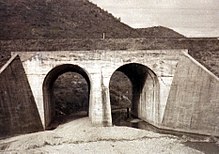
The stone bridge near the village of No Gun Ri (another one of these strangely appropriate historical proper names, like Benjamin 'Helburn' Sachs)spans a small stream. It is similar to a great many others that cross the landscape of South Korea, except that the walls of this bridge were, until very recently, pockmarked by hundreds of bullet holes. On the very day that the US 8th Army delivered its stop refugee order in July 1950, up to 400 South Korean civilians gathered by the bridge were killed by US forces from the 7th Cavalry Regiment. Some were shot above the bridge, on the railroad tracks. Others were strafed by US planes. More were killed under the arches in an ordeal that local survivors say lasted for three days.
'The floor under the bridge was a mixture of gravel and sand. People clawed with their bare hands to make holes to hide in,' recalls survivor Yang Hae Chan. 'Other people piled up the dead like a barricade, and hid behind the bodies as a shield against the bullets.'
Corroborating the Korean survivors' testimony are the accounts of 35 veterans of the 7th Cavalry Regiment who recall events at No Gun Ri. Perspectives differ, but the detailed memories of veterans recalling events burnt into their souls by their first days in combat are as painful as they are shocking.
'There was a lieutenant screaming like a madman, fire on everything, kill 'em all,' recalls 7th Cavalry veteran Joe Jackman. 'I didn't know if they were soldiers or what. Kids, there was kids out there, it didn't matter what it was, eight to 80, blind, crippled or crazy, they shot 'em all.'(Obama would have found great joy guiding drone strikes back then)
Along with the My Lai atrocity 20 years later in Vietnam, the killings discovered at No Gun Ri mark one of the largest single massacres of civilians by American forces in the 20th century. When the news of the killings at No Gun Ri was first broken by a team of investigative journalists from the Associated Press in September 1999, the effects were to be as seismic as the allegations themselves.
America was deeply shocked by the AP report.(most of us couldn't care any less, to be honest) Previously, the US Army had dismissed the claims of South Korean survivors who, since 1960, had been trying to tell the truth about the killings at No Gun Ri. The Army said that US forces were not even in the area of No Gun Ri at the time of the killings. But not only did new evidence put No Gun Ri firmly within the US 7th Cavalry area of operations at the time, the discovery of US veterans willing to talk about events 50 years later made the massacre undeniable. The Clinton administration quickly directed that the Pentagon, specifically the Army, conduct an investigation into what actually happened at No Gun Ri.
Since the original AP report, more documents detailing refugee 'kill' orders have been unearthed at the US national archives. They point to the widespread targeting of refugees by commanders well after No Gun Ri. In August 1950 there were orders detailing that refugees crossing the Naktong River be shot. Later in the same month, General Gay, commander of the 1st Cavalry Division (of which the 7th Cavalry Regiment involved at No Gun Ri was part), actually ordered artillery units to target civilians on the battlefield. And as late as January 1951, the US 8th Army was detailing all units in Korea that refugees be attacked with all available fire including bombing.
New allegations have also emerged of the indiscriminate killing of civilians in Korea. In August 1950, 80 civilians are reported to have been killed while seeking sanctuary in a shrine by the village of Kokaan-Ri, near Masan in South Korea. Other survivors recall 400 civilians killed by US naval artillery on the beaches near the port of Pohang in September 1950, and dozens of villages across southern South Korea report the repeated low-level strafing by US planes of 'people in white' during July and August 1950. A total of 61 separate incidents involving the killing of civilians by US forces are now logged with the South Korean authorities.
The Pentagon inquiry into No Gun Ri was finally released in January 2001. The basis of its conclusions are doubtful. The investigation acknowledged the killing of civilians at No Gun Ri by US forces, but it concluded that the killings that took place there were not deliberate attacks but 'an unfortunate tragedy inherent to war'.(it's always 'unfortunate' after the fact when it is other families that get blown away)
Yet whatever the confusion on the battlefield at the time, clear orders had been given by command not to let refugees through the lines. More importantly, documents showed orders had actually been received by the 8th Cavalry Regiment, sister to the 7th Cavalry involved at No Gun Ri. 'No refugees to cross the line. Fire everyone trying to cross the lines. Use discretion in the case of women and children.' This was an order from the headquarters of the 1st Cavalry Division.
More documents were discovered that showed that the Air Force was strafing civilians at the request of the Army. Air Force Colonel Turner Rogers wrote a memo the day before events at No Gun Ri. 'The Army has requested we strafe all civilian refugee parties that are noted approaching our positions,' the memo read. It went on to confirm the instructions had been acted upon. 'To date, we have complied with the army request in this respect.'
Despite this the Pentagon maintains in the report that no orders were issued to shoot refugees at No Gun Ri. This rather narrow frame of reference effectively ignores whatever evidence there might be of other orders given at the time to treat civilians as the enemy. Only orders specifically mentioning No Gun Ri would qualify. Even so this is a surprising conclusion to draw for a number of other reasons.
Firstly, the oral testimony given by veterans of the 7th Cavalry to the Pentagon during its 14-month investigation may contradict the Pentagon's position. This evidence has never been made fully public, but what has been discovered by those allowed access to the material, is that a significant number of the veterans interviewed did in fact recall orders to open fire on the civilians at No Gun Ri.
Secondly, the 7th Cavalry communications log - the log that might have contained evidence of such orders had they been given - has gone missing. (Probably blown up by the Muslims who expertly flew their jumbo jet into the Pentagon) The significance of this is highlighted by Charles Hanley, one of the AP journalists who first investigated No Gun Ri. '[The Pentagon] report declares that there were no orders at No Gun Ri - and it declares that flatly - but it doesn't have the document that would prove that one way or the other.'
The inconsistencies that surround the Pentagon's investigation have even led those brought in as independent advisors to voice doubts. Pete McCloskey, a decorated Korean War veteran and former Congressman, was brought in to advise on the Pentagon report. He was disappointed with what was finally published. 'I think the American government, the Pentagon and most government agencies don't want to see the truth come out if it will embarrass the government.
'I think it's almost a rule of political science. The government will always lie about embarrassing matters.(Ditto any governmental agency, from the local police investigating itself on charges of police brutality to the top generals in DC) And when you are up in the Pentagon a full Colonel and have a chance to make General, and General with the chance to become Chief of Staff, there's as much politics high in the Pentagon as there is in the halls of Congress. And I think that the Army just chose to try and down play the terrible character of Army leadership in 1950.'(there's also no incentive to come out with the truth. Americans no longer give a damn, the media refuses to report on it, and the politician doesn't get paid off for it - so in the end only a few rabble-rousers give a damn)
It is now nearly 50 years since the end of the conflict in Korea. The only major American investigation into the killing of refugees focused exclusively on the activities of the US Army over a small geographic area during one month of a conflict that lasted three years. Contradicting testimony from veterans and Korean survivors, the report concluded that there was no evidence to suggest that orders to kill civilians were given at No Gun Ri. Clearly there are still many unanswered questions over American involvement in Korea, questions that were not answered by the narrow view of the US Army's investigation. Yet this burden now falls not on those responsible for giving the orders, but on the veterans and survivors alike.
My heart goes out to all in this situation - the American serviceman as well as the S & N Korean soldiers and of course the innocents caught in the crossfire.
America is fully ramped up for incessant warfare today - one thing the Bush White House wasn't lying about was when it was said this latest war could last a century or longer. It is essential to warn young people not to join the military or in fact any cancerous growth of this government. (See: here)
I admit to not knowing if the NK government is autonomous or simply another tool of the jew world order (I tend to lean to the second choice though). There's sure a lot of weirdness though, when it comes to the US/NK relationship; most recently expressed by the State Sponsored visit of Dennis Rodman to the nation. While he likely made a lot more sense to the NK government and people than say, a few jetloads of State Department hacks, Rodman's visit makes the relationship between these 2 nations all the more surreal.
By all appearances the US is gearing up for a fight at another front in the 'war of on terror'. It may be this time America's military will face a foe with some ability to fight back. That's something no sane human should want to see or experience.
For more background see this, an: An Earlier Post.